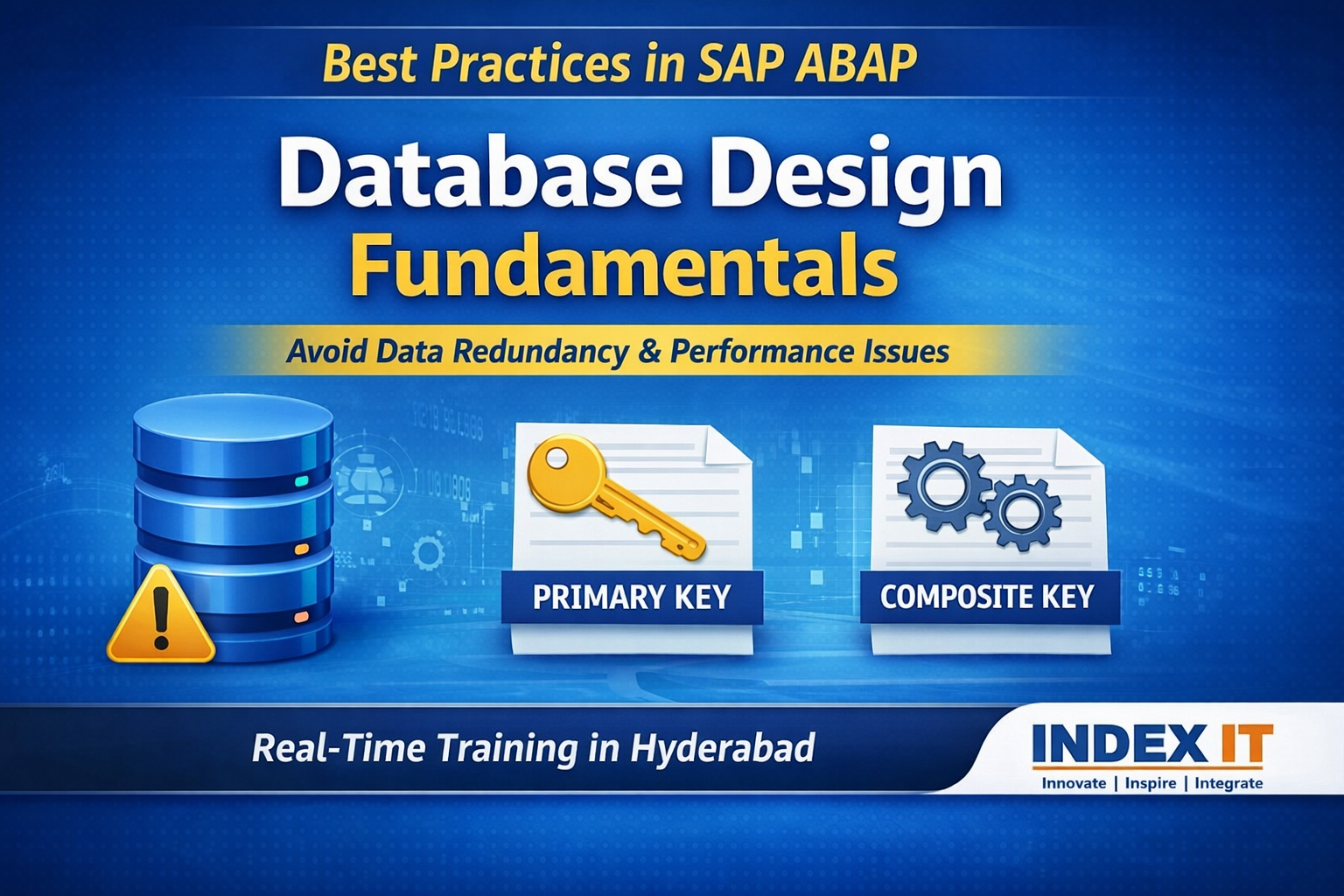
Why Database Fundamentals Are Important in SAP ABAP – Real-Time Example Explained

SAP ABAP course in Hyderabad explaining database fundamentals and primary key concepts at Index IT

Real-time SAP ABAP database fundamentals training in Hyderabad at Index IT.

When students start learning SAP ABAP, most of them focus only on writing programs.

But experienced consultants know one important truth:

If your database design is wrong, your entire application will fail.

In today’s SAP projects, proper database understanding is more important than just coding.

In this article, let’s understand database fundamentals in a simple and practical way using real-time examples.

Why Database Design Matters in SAP

Every software application has two main purposes:

  • Store data
  • Retrieve data

Without tables, there is no program. Without proper database structure, there is no stable application.

In SAP, the database acts like the foundation of a building.

If the foundation is weak, the building will collapse.

In the same way, if tables are poorly designed:

  • Data duplication increases
  • Performance issues occur
  • Maintenance becomes difficult
  • Application crashes may happen

That’s why understanding database concepts is crucial while learning SAP ABAP.

Rule 1: Never Create a Single Table for Everything

Many beginners make this mistake.

Example:

If you want to build a simple banking application like Google Pay, you may try to store:

  • Customer Name
  • City
  • Phone Number
  • Date of Birth
  • Transaction Date
  • Credit / Debit
  • Amount
  • Currency

If you store everything in one single table, what happens?

Customer personal data gets repeated for every transaction.

If a person does 1000 transactions:

  • His name repeats 1000 times
  • His phone number repeats 1000 times
  • His date of birth repeats 1000 times
This is called Data Redundancy.

Good database design always avoids duplication.

Master Data vs Transaction Data

To avoid data redundancy, we divide information into two main categories:

1️⃣ Master Data

Master data is information that rarely changes or never changes.

  • Name
  • Date of Birth
  • Gender
  • Phone Number
  • Address

2️⃣ Transaction Data

Transaction data changes frequently based on user activity.

  • Transaction Date
  • Credit / Debit Type
  • Amount
  • Attendance Records
  • Salary Payments
Master data remains stable, while transaction data keeps changing regularly.

Separating these two types of data improves performance, reduces duplication, and makes your SAP application more scalable and efficient.

What is a Primary Key in SAP?

In SAP, you cannot create a table without defining a Primary Key.

A Primary Key is a unique identifier of a table. It ensures that every record stored in the database can be uniquely identified.

Without a Primary Key, SAP will not activate the table.

For example:

  • In Banking – Account Number acts as Primary Key
  • In a Company – Employee ID acts as Primary Key

The main purpose of a Primary Key is:

  • Prevent duplicate records
  • Maintain data integrity
  • Ensure unique identification
Choosing the correct Primary Key is critical. If you select the wrong key field, your entire database design can fail.

That’s why understanding how to select proper key fields is an essential skill for every SAP ABAP developer.

Composite Primary Key – Real-Time Example Explained

Many students think a Primary Key must always be a single field.

That is not correct.

In SAP, a Primary Key can be a combination of multiple fields.

This is called a Composite Primary Key.

Real-Time Example: Employee Attendance

Suppose we want to store employee attendance with the following fields:

  • Employee ID
  • Attendance Date
  • Status (Present / Absent)

If we keep only Employee ID as the Primary Key, the system will not allow multiple attendance records for the same employee.

But attendance must be recorded every day.

So the correct Primary Key should be: Employee ID + Attendance Date

This combination ensures that:

  • One employee can have multiple attendance records
  • Only one record per employee per day is allowed
  • Duplicate entries are prevented
In SAP, a table can have only one Primary Key — but that key can contain multiple fields (maximum 16 fields).

Understanding composite keys is extremely important for interviews and real-time project scenarios.

How Wrong Key Selection Creates Real-Time Problems

Choosing the wrong primary key can create serious issues in real-time SAP projects.

Let’s understand this with a simple example.

Scenario: Two Employees with Same ID

Suppose two HR users create employee records at the same time. If the primary key is not designed properly, the system may allow duplicate employee IDs.

  • Employee 001 – Hyderabad
  • Employee 001 – Bangalore

Now imagine salary processing starts.

  • Which Employee 001 should receive salary?
  • Which record should be updated?
  • Which record should be deleted?

Wrong key selection leads to data confusion, salary errors, reporting issues, and system instability.

In high-volume systems like banking or e-commerce applications, even a small design mistake can damage company reputation.

Correct database design is not optional — it is mandatory for stable SAP applications.

That is why experienced SAP consultants always focus on database design before writing programs.

Why Strong Fundamentals Are Important for a Successful SAP ABAP Career

SAP ABAP is not just about writing code.

It is about designing proper database structures, selecting the right primary keys, avoiding redundancy, and building scalable applications.

When your fundamentals are strong:

  • You answer interview questions confidently
  • You understand real-time project scenarios easily
  • You avoid common beginner mistakes
  • You become a valuable technical consultant

If you are serious about building a strong foundation and learning SAP step by step with real-time examples, explore our detailed sap abap course in hyderabad .

Our training focuses on database fundamentals, practical sessions, interview preparation, and real-time project understanding.

Build your SAP career with clarity, confidence, and strong technical knowledge.

Leave a Reply

Your email address will not be published. Required fields are marked *