Our Location
Index IT SAP St, Gayatri Nagar, Srinivasa Nagar,
Ameerpet, Hyderabad, Telangana - 500016
Phone: +91-8977802802
Email: indexit4sap@gmail.com
Index IT SAP St, Gayatri Nagar, Srinivasa Nagar,
Ameerpet, Hyderabad, Telangana - 500016
Phone: +91-8977802802
Email: indexit4sap@gmail.com
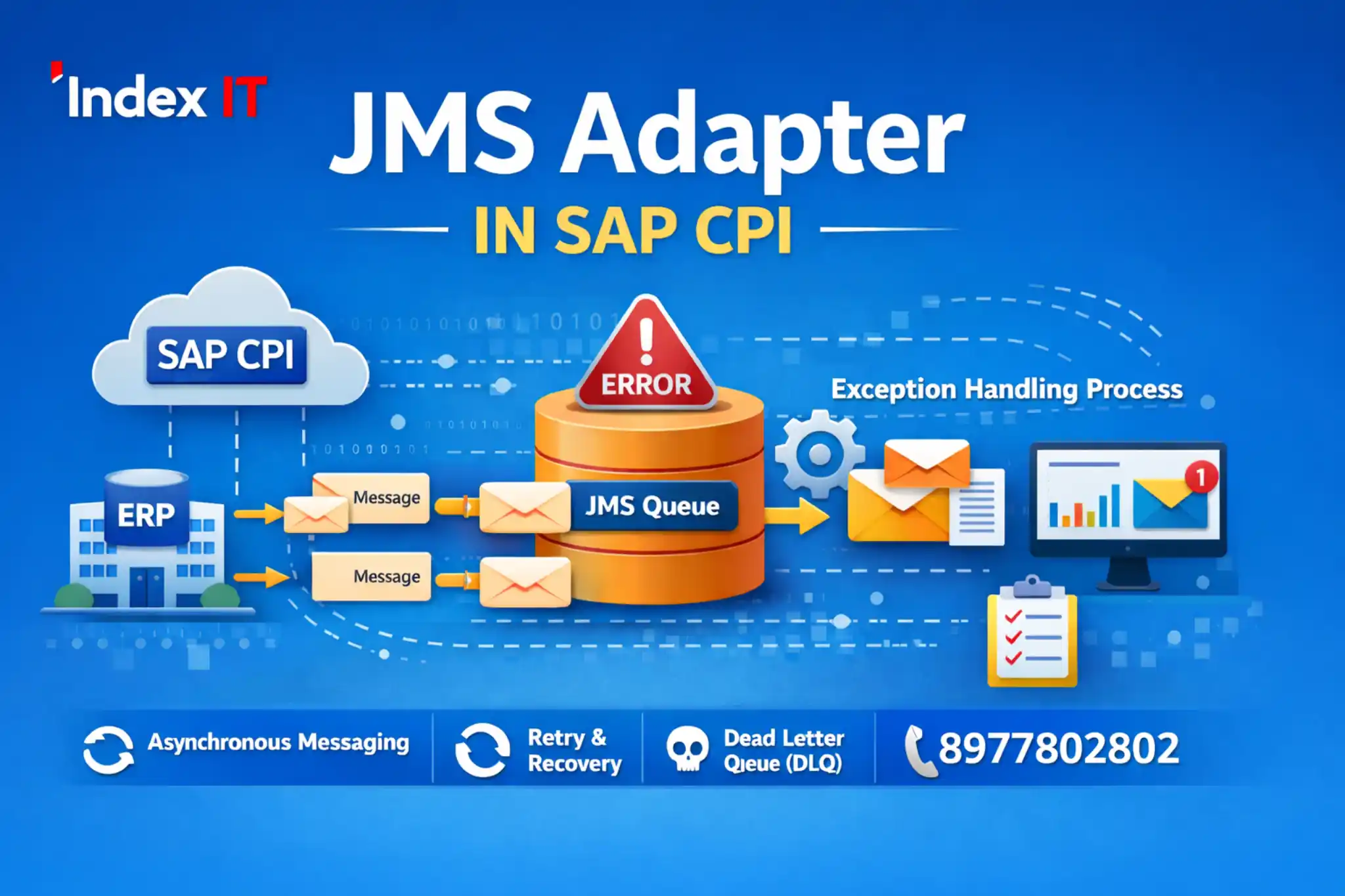
When working with SAP integrations, message failures are unavoidable. In real-time production environments, connectivity issues or data problems can cause message processing to fail.
This is where the JMS Adapter in SAP CPI becomes critical.
In this detailed guide, we will explain:
If you are learning SAP CPI or working on live integration projects, this guide will give you practical clarity.
To gain hands-on experience in JMS Adapter and retry mechanisms, enrolling in a real-time SAP CPI training program can help you build strong practical knowledge with live project scenarios.

In SAP Cloud Platform Integration (SAP CPI), JMS stands for Java Messaging Service.
It is used to:
Instead of directly sending a message to the receiver system, you can first store it in a JMS queue. Another iFlow can later consume and process it safely.
This improves system reliability and stability.
In real-time SAP integration projects, message failures are common. Understanding the reasons behind these failures helps in designing a stable and reliable integration architecture.
Messages typically fail due to the following reasons:
In production environments, the most common causes are connectivity issues and data problems. This is where the JMS Adapter plays an important role by enabling automatic retry and safe message storage.
The JMS Adapter in SAP CPI is widely used to implement a reliable retry mechanism in integration scenarios.
Instead of directly sending messages to the receiver system, the message is first stored in a JMS Queue. A separate iFlow then reads the message from the queue and processes it.
Here is how the retry mechanism works:
This design ensures that messages are not lost due to temporary system failures. It provides better stability, fault tolerance, and production-level reliability.
By configuring parameters such as retry interval, maximum retry count, and retention period, developers can fully control the behavior of the retry mechanism.
In real-time SAP CPI projects, the most recommended design pattern for implementing JMS is the two iFlow architecture.
This approach separates message storage and message processing, improving scalability and system reliability.
iFlow 1: Sender → JMS Receiver
iFlow 2: JMS Sender → Target System (Email, API, SFTP, etc.)
Here’s how it works:
By separating responsibilities into two iFlows, you reduce tight coupling between systems and create a more stable integration landscape.
This architecture is commonly used in enterprise-level SAP Integration projects to ensure high availability and controlled error handling.
Proper configuration of the JMS Adapter in SAP CPI is essential to ensure reliable message processing and controlled retry behavior in production systems.
Below are the key configuration parameters you should understand:
Correctly configuring these parameters helps in building scalable, fault-tolerant, and production-ready SAP CPI integrations.
Both Data Store and JMS Adapter in SAP CPI are used to store messages within the tenant. However, their purpose and usage scenarios are different.
Understanding this difference helps you design the right integration architecture.
If your requirement involves retry handling and reliable asynchronous processing, JMS Adapter is generally the recommended approach.
If your requirement is simple message storage for later processing by another iFlow, Data Store can be used effectively.
In real-time SAP CPI projects, exception handling is a critical part of integration design. Instead of losing failed messages, organizations implement structured recovery mechanisms using the JMS Adapter.
When an error occurs in the main iFlow, the system can automatically move the failed message to an Exception Subprocess.
From there, the message can be:
Using JMS for exception handling ensures that failed messages are safely preserved instead of being permanently lost.
In enterprise environments, a separate “Failed Message iFlow” is often designed to consume messages from the failure queue and reprocess them after resolving the root cause.
This approach significantly improves reliability, traceability, and system resilience in SAP CPI landscapes.
Implementing JMS Adapter correctly in production environments is essential for building stable and scalable SAP CPI integrations.
Below are some recommended best practices followed in enterprise projects:
Following these best practices ensures better fault tolerance, controlled recovery, and long-term maintainability of SAP CPI solutions.
If you want to gain hands-on experience in SAP CPI, including JMS Adapter, retry mechanisms, exception handling, Groovy scripting, and real-time iFlow design, structured practical training makes a big difference.
Explore our detailed SAP CPI Online Training in Hyderabad to understand course curriculum, real-time project coverage, and batch details.
For personalized guidance, you can also reach out directly.
📍 Ameerpet, Hyderabad
📞 8977802802
Build strong integration skills with real-time scenarios and move confidently toward SAP Integration career opportunities.
